
What to Do When Your AC Breaks Down: Temporary Cooling Solutions
An unexpected air conditioning breakdown can quickly become a serious operational problem in Abu Dhabi. High temperatures can make offices, commercial spaces, construction sites, equipment rooms and temporary facilities uncomfortable or difficult to operate.
While permanent AC repairs or replacement may take time, businesses do not always have to wait without cooling.
Temporary cooling solutions can help maintain comfortable and usable conditions while the main air conditioning system is being repaired or replaced.
What Should You Do When Your AC Suddenly Stops Working?
When an AC system fails, the first step is to determine whether the problem can be resolved through a routine service call or whether temporary cooling is required.
For businesses and project sites, consider these immediate steps:
- Check whether the issue affects one unit or the entire facility.
- Contact your HVAC maintenance provider.
- Identify areas that require immediate cooling.
- Move sensitive equipment away from excessive heat where possible.
- Consider temporary cooling if repairs cannot be completed quickly.
- Choose equipment based on the space, cooling load and available power.
For critical areas, delaying temporary cooling can result in uncomfortable working conditions and may affect temperature-sensitive equipment.
When Do You Need Temporary Cooling?
Temporary cooling can be useful when permanent HVAC capacity is unavailable, insufficient or temporarily disrupted.
Common situations include:
AC System Breakdown
A major HVAC failure can leave an office, warehouse, commercial facility or work area without sufficient cooling.
Temporary equipment can provide interim cooling while technicians diagnose and repair the permanent system.
HVAC Replacement or Upgrades
Replacing a large AC system can take time. During installation or major HVAC upgrades, temporary cooling can help keep occupied areas operational.
Construction and Fit-Out Projects
New buildings and renovated spaces may not have their permanent HVAC systems operational during construction or fit-out.
Temporary cooling can provide suitable conditions for workers, site offices and project areas until the permanent system is commissioned.
Events and Temporary Structures
Events, exhibitions and temporary structures can have cooling requirements that are different from permanent buildings.
Temporary cooling equipment can be deployed for specific event areas without requiring a permanent HVAC installation.
Additional Cooling Capacity
Sometimes the existing AC system is operating but cannot provide enough cooling because of increased occupancy, additional equipment or changing operational requirements.
Additional temporary cooling can help address these short-term increases in demand.
What Types of Temporary Cooling Can Be Used?
The appropriate solution depends on the size and purpose of the area.
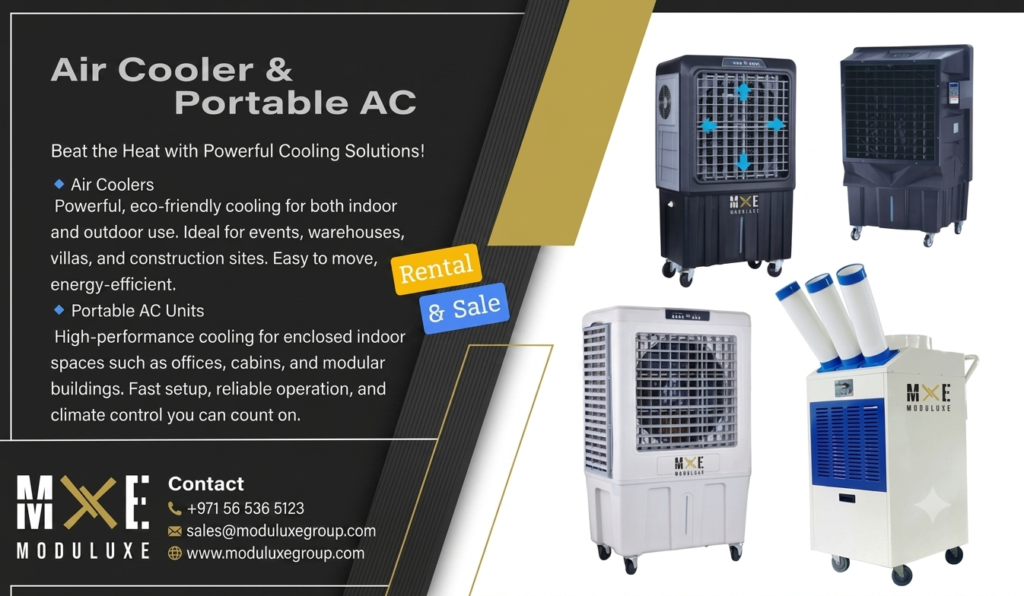
Portable Air Conditioners
Portable AC units can provide cooling for enclosed spaces where flexible deployment is required.
They may be suitable for:
- Temporary offices
- Site cabins
- Small work areas
- Server rooms
- Individual rooms
- Security cabins
Their portability makes them useful when cooling requirements change between areas.
Spot Coolers
Spot cooling focuses cooled air on a specific area rather than cooling an entire building.
This can be useful for:
- Equipment
- Workstations
- Control rooms
- Electrical areas
- Server rooms
- Localized hot spots
Spot cooling can be particularly useful when only a specific area is experiencing excessive heat.
Package AC Systems
For larger temporary spaces, higher-capacity package AC systems may be more appropriate.
They can be considered for applications such as:
- Warehouses
- Temporary buildings
- Large workspaces
- Commercial areas
- Industrial facilities
Tent Cooling
Temporary structures such as event tents can require dedicated cooling because they may have significant heat gain from outdoor temperatures, occupancy and lighting.
Tent cooling systems can be configured to distribute conditioned air across the occupied area.
Industrial Cooling Systems
Industrial environments can have substantial cooling requirements because of machinery, equipment, processes and large open areas.
Higher-capacity temporary cooling systems may be required where standard portable units are insufficient.
How Do You Choose the Right Temporary Cooling Equipment?
Selecting a temporary AC should not be based only on the size of the room.
Several factors can influence the cooling requirement.
1. Area to Be Cooled
Start by identifying the approximate floor area and ceiling height.
Larger or high-ceiling spaces may require substantially more cooling capacity than a standard office.
2. Number of People
People generate heat. A crowded office, event space or meeting room can therefore require more cooling than a lightly occupied space of the same size.
3. Heat-Generating Equipment
Computers, servers, machinery, lighting and electrical equipment can increase the heat load.
For equipment rooms, the cooling requirement should account for the heat generated by the equipment itself.
4. Doors and Windows
Frequently opened doors, large windows and poor insulation can increase the amount of cooling required.
5. Available Power
The available electrical supply should be checked before equipment is selected.
A cooling system must be compatible with the site’s electrical infrastructure.
6. Duration of the Requirement
A cooling requirement lasting a few days may require a different approach from one lasting several months.
The expected duration should be discussed with the rental provider before equipment is deployed.
Can Temporary Cooling Keep a Business Operating During an AC Failure?
In many situations, temporary cooling can help businesses continue operations while permanent HVAC repairs are underway.
For example, an office experiencing a major AC failure may use temporary units to cool occupied workspaces while the main system is repaired.
Similarly, a construction project may use temporary cooling in site offices before the permanent building HVAC system becomes operational.
The objective is not necessarily to replace the permanent HVAC system. Instead, temporary cooling provides an interim solution for the period when normal cooling capacity is unavailable.
Temporary Cooling for Critical Areas
Some spaces require greater attention because excessive heat can affect equipment, operations or working conditions.
These may include:
- Server rooms
- Control rooms
- Electrical rooms
- Equipment areas
- Medical or technical spaces
- Production environments
- Communication rooms
For these applications, the cooling requirement should be assessed based on the equipment and operating conditions rather than relying only on general room size.
Where temperature control is critical, businesses should also consider redundancy and backup cooling requirements.
How Quickly Can Temporary Cooling Be Arranged?
The deployment time depends on equipment availability, site location, cooling requirements, electrical infrastructure and installation requirements.
For urgent situations, provide the cooling provider with as much information as possible:
- Site location
- Type of facility
- Approximate area
- Number of rooms
- Current AC problem
- Required cooling areas
- Available power supply
- Required start date
- Expected rental duration
Providing these details early can help the provider determine the appropriate equipment and deployment requirements.
Should You Repair the AC or Use Temporary Cooling?
In many cases, the two solutions work together.
Permanent repair addresses the underlying HVAC problem, while temporary cooling maintains usable conditions during the repair period.
Temporary cooling may be particularly useful when:
- Spare parts are delayed
- A major component has failed
- A replacement system is being installed
- The building requires additional cooling
- The repair is expected to take several days
- Critical areas cannot remain without cooling
The appropriate approach depends on the severity of the failure, expected repair time and operational requirements.
Why Renting Can Help During an AC Emergency
Purchasing new equipment may not be practical when the cooling requirement is temporary.
Rental can provide access to suitable equipment for the required period without requiring the business to permanently own equipment that may have limited use after the emergency.
This can be useful for:
- Short-term breakdowns
- Temporary projects
- Events
- Construction sites
- Seasonal requirements
- Emergency replacement cooling
For businesses that need a temporary solution, AC Rental Abu Dhabi can provide access to different types of cooling equipment based on the application and duration required.
Temporary Cooling for Construction Sites
Construction environments can experience changing cooling requirements throughout a project.
Temporary site offices, cabins, worker facilities and enclosed workspaces may need cooling before permanent HVAC systems are available.
As the project progresses, cooling requirements can also change.
Portable and temporary systems provide flexibility without requiring a permanent installation for a facility that may only be used during the construction period.
Temporary Cooling for Offices and Commercial Spaces
An office AC failure can affect employee comfort and normal business operations.
If only one section of the office has lost cooling, targeted portable or spot cooling may be sufficient.
If the entire facility is affected, a higher-capacity temporary system may be required.
The appropriate solution depends on the size of the affected area, occupancy, existing HVAC configuration and available power.
Temporary Cooling for Events
Event organizers cannot always rely entirely on existing venue HVAC systems, particularly when the event takes place inside temporary structures or outdoor spaces.
Temporary cooling can be planned according to:
- Tent or venue dimensions
- Expected attendance
- Event duration
- Outdoor temperature
- Lighting and equipment
- Structure and insulation
- Available power
Planning cooling before the event can help reduce the risk of uncomfortable conditions during the event.
Why Choose Moduluxe for Temporary Cooling?
Moduluxe provides temporary HVAC and cooling solutions for construction sites, offices, events, industrial applications, warehouses, server rooms and other temporary facilities.
Its HVAC rental solutions include:
- Portable AC units
- Package AC units
- Split AC systems
- Spot coolers
- Tent cooling
- Industrial cooling solutions
Moduluxe also provides installation, maintenance and technical support for temporary cooling requirements.
With different equipment options available, the cooling solution can be selected according to the application, site conditions and required duration.
Frequently Asked Questions
What is temporary cooling?
Temporary cooling is the use of portable or temporary HVAC equipment to provide cooling when a permanent AC system is unavailable, insufficient or not yet installed.
What can I use if my office AC breaks down?
Depending on the size of the affected area, portable AC units, spot coolers or higher-capacity temporary cooling systems can be considered while the permanent AC system is being repaired.
Can temporary AC be used during construction?
Yes. Temporary AC systems can be used for construction offices, site cabins, enclosed workspaces and other areas where permanent HVAC is not yet operational.
Can I get emergency cooling for a server room?
Temporary cooling can be used for server and equipment rooms, but the required capacity should be determined based on the equipment’s heat output, room conditions and required operating temperature.
Is temporary cooling suitable for events?
Yes. Temporary cooling can be used for exhibitions, conferences, weddings, corporate events and tented events. The system should be selected based on the structure, occupancy and cooling load.
How long can temporary AC be used?
Temporary AC equipment can be used for short-term requirements or longer projects, depending on the rental arrangement and equipment suitability.
How do I arrange temporary cooling?
Provide the cooling provider with the site location, space dimensions, application, expected occupancy, available power and required rental duration. This information helps determine the appropriate cooling solution.
Need Temporary Cooling?
An AC breakdown does not necessarily mean your business or project has to stop.
Whether you need temporary cooling for an office, construction site, event, warehouse, equipment room or emergency situation, the right equipment can help maintain suitable conditions while your permanent cooling system is repaired or replaced.
For temporary and emergency cooling requirements in Abu Dhabi, contact Moduluxe to discuss your site requirements and available cooling options.